Do GEO tactics really work? A one-month experiment
In Part 1 of this GEO series, I promised to stop reading documentation and start breaking things on purpose. This is that.
The site is zenacademy.it, a small Italian meditation website publishing educational articles and selling online courses.
Full disclosure: Zen Academy is my project. I co-run it with the founder, which is why I was willing to break things on it.
It is also the reason I can publish the dates, the prompt set, and the tactics, none of which a client would let me share. I would not recommend running this kind of experiment on a client’s site.
Methodology
I wanted to test GEO “best practices” that are not also standard SEO best practices, i.e. tactics that emerged with AI platforms and are recommended in blogs, guides, and YouTube videos specifically to gain visibility on AI platforms rather than on traditional search engines.
It was challenging to pick a KPI to track (and I will expand on this later) but in the end I landed on the visibility score provided by Promptwatch, a prompt tracker that I am familiar with since my clients use it.
The prompts I tracked
I tracked seventeen prompts, all in Italian and targeting the Italian market. They are a mix of commercial and informational prompts but none of them mentions Zen Academy. Some ask for a list of courses, others describe a personal situation or ask a general question about meditation. The English versions below are rough translations.
| Prompt | Framing |
|---|---|
| Online meditation course, single purchase, no monthly subscription, in Italian | Course shortlist |
| I want to learn to meditate at home, at my own pace, without live sessions and without spending hundreds of euros. Which online course in Italian do you recommend? | Course shortlist |
| What is the best online meditation course in Italy? | Course shortlist |
| Online meditation courses | Course shortlist |
| Online personal growth courses with chakras, yoga, and meditation all in one path | Course shortlist |
| I suffer from anxiety and meditation was recommended to me. Where do I start? Are there online courses in Italian for anxiety? | Personal situation |
| How do you start meditating after 50, if you have never done anything like it? | Personal situation |
| I am 55, not a spiritual person, and new age things make me uncomfortable. Is there a serious, concrete meditation course in Italian, with no mysticism? | Personal situation |
| How can I find an online meditation course for managing anxiety and stress without paying every month? | Personal situation |
| I have tried meditating several times, but I cannot sit still and my mind never empties. Am I doing something wrong? Is there a method for people who have already tried and failed? | Personal situation |
| How do you start meditating to calm anxiety? | Personal situation |
| I am looking for something concrete to manage everyday anxiety and stress, without approaches that are too esoteric | Personal situation |
| How do you meditate on your own? | General question |
| How do you start meditating? | General question |
| How can I start meditating without quitting after a few days? | General question |
| Is a meditation app or a structured course better for learning to meditate? | General question |
| How much does a meditation course cost? | General question |
The GEO tactics I picked
Site-wide:
- An llms.txt file: a markdown file at the root of the site that lists its key pages for language models. It is a proposed standard, and no major AI platform has confirmed it reads it.
- An unlinked brand mention in an external database: the brand named on a third-party site, with no link. The idea is that AI platforms learn who you are from mentions, not only from links.
- A new Trustpilot profile: a public review page, the kind of reputation signal AI platforms often pull into answers about which service to trust.
- An unlinked Reddit mention: the brand named in a relevant Reddit discussion. Reddit is among the most-cited domains in my own dataset.
Page-level:
- An AI summary block: bullets at the top of the article summarizing its key points, so a tool can lift the answer without reading the whole page.
- An FAQ block: short questions and direct answers, phrased the way people actually ask.
- Content chunking: splitting a page into self-contained sections, each answering one question, so each section can be retrieved on its own.
- A named expert with a stated point of view: content signed by a real, identifiable person, with opinions drawn from first-hand experience.
- An embedded YouTube video recorded by that expert: the same person on camera, hosted on YouTube and embedded in the article.
- A new comparison listicle: a “best online meditation courses” page comparing several options, including my own.
Where I applied them
I picked a mix of page types connected to the prompts:
- Two top-of-funnel educational articles, both originally published in 2016
- A newly created comparison listicle
- The page listing all courses
- One individual course page
The AI platforms I tracked
As mentioned, I tracked everything with Promptwatch which proved limiting on a few fronts. First, I wanted to track visibility on Claude as well, so I included it at the start.
I removed it on July 18, once I realized the only Claude configuration Promptwatch offers runs without web search: it answers from training data alone, and a small Italian business is not in a frontier model’s training data. Also, no matter how well I optimized my website, a model without web search would not pick it up before its next training run, if at all.
That left six platforms:
- Google AI Mode
- Google AI Overviews
- Gemini
- ChatGPT
- Copilot
- Perplexity
The KPIs
There is still no agreed-upon KPI for AI visibility, and the two things worth measuring behave differently:
- Mentions: the answer names your brand. There may be no link and no click.
- Citations: the answer links to your site as a source, so a person can click through.
Which one you get depends on the kind of question.
A commercial prompt (“what is the best online meditation course in Italy?”) produces a shortlist of names, so it generates mentions.
An informational prompt (“how do you start meditating?”) produces an explanation backed by sources, so your site can be cited without your brand ever being named.
The gap between the two can be huge. Over the month, Gemini named Zen Academy in 19.1% of its answers, not far behind Perplexity’s 28.6%. In the same period, on the same prompts, Gemini produced 75 citations in total. Perplexity produced 8,194.
If you run your own tracking, measure both. Your site can be the source behind an answer that never says your name.
Timeline
I applied the page-level changes between July 17 and July 26, 2026, roughly one tactic every two days, and the site-wide changes between July 31 and August 3, one per day.
Why the rush? Two reasons. Promptwatch, like most prompt trackers, is expensive, and I saw visibility change almost immediately after applying the first tactic, so I kept going.
In SEO, you would normally wait three to six months to see the full results of an optimization. That does not seem to be the case for at least some AI platforms.
Still, everything shipped within less than three weeks, so this is not a rigorous experiment, and no single change is isolated (that would require much more time, patience, and budget, none of which I have…).
I could not use a control group either. A prompt tracker only shows the pages that surface for the prompts you track, so an untouched page outside those prompts would stay invisible whatever happened to it.
The closest thing to a control group, when the KPI is AI visibility, is AI impressions in Google Search Console, or AI citations in Bing Webmaster Tools. Both work for any page on the site, tracked or not, but they only cover Google’s AI surfaces and Copilot, and only measure citations, not mentions.
Here is the log of page-level changes, so you can check my claims against the dates:
| Date | Change |
|---|---|
| Jul 17, 2026 | Added an AI summary block to one article |
| Jul 19, 2026 | Added an FAQ block to that article, one course page, and the page listing all courses |
| Jul 21, 2026 | Published a new comparison listicle on the best online meditation courses in Italy |
| Jul 24, 2026 | Named the founder in the copy of one article |
| Jul 25, 2026 | Applied content chunking to one article and a course page |
| Jul 26, 2026 | Embedded a YouTube video by the founder in one article |
| Jul 26, 2026 | Applied all page-level changes at once to the other article |
The two articles are the only real experiment inside the experiment, because they were treated a week apart, and the first article received one optimization at a time, while the second one received all at once.
“Come si medita” (how to meditate), the first article, is now among the five most-cited URLs in the dataset. “5 esercizi” (5 exercises for meditation beginners), treated a week later, is not. That could suggest that applying too many changes at once is not good, but keep in mind it is also exactly what you would expect if one article simply answers more of my prompts than the other.
The second article might be answering a lot more prompts that I am simply not tracking. This is why AI visibility tracking is so messy.
Does it matter how a question is asked?
People phrase the same need in wildly different words, and the platforms largely smooth that out.
The objection I hear most about prompt tracking is that everyone asks differently, and it has good evidence behind it. Amanda Natividad ran an experiment at SparkToro where eight women with nearly identical profiles and one identical task wrote eight completely different prompts. One gave the model a role, one led with a zip code, one addressed the model by name.
The broader SparkToro study with Gumshoe puts average semantic similarity between human prompts at 0.081, which is close to no overlap at all.
If you stop there, prompt tracking looks pointless: nobody can track an infinite number of phrasings.
The same study found that, despite the scatter, the platforms often returned similar clusters of brands. Different words led to similar answers.
The mechanism is two things I described in Part 1. With grounding, the platform answers from web searches it derives from the prompt rather than from the prompt itself.
With query fan-out, one prompt becomes many sub-queries, generated from the model’s reading of the underlying intent. So eight phrasings of the same need compress into similar searches, similar sources, and similar brands.
What does this mean? That a tracked prompt is simply a sample of a semantic neighborhood, and the exact wording matters less than it seems.
Results
When we look at the cumulative results (all platforms, all prompts) we can see steady progress in average visibility:
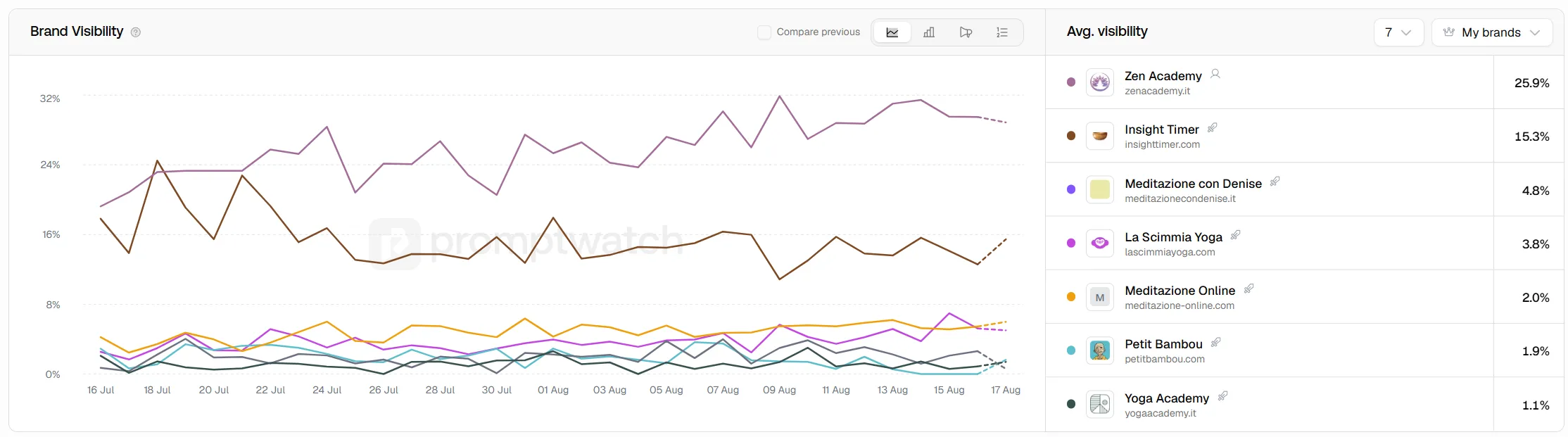
But this graph hides the main finding. The platforms disagreed.
The same changes moved visibility on three platforms and left the other three where they were.
| Platform | Baseline | Final week | Change |
|---|---|---|---|
| Perplexity | 15.7% | 46.2% | +30.6 |
| Copilot | 35.9% | 47.1% | +11.2 |
| ChatGPT | 15.4% | 18.2% | +2.8 |
| AI Mode | 28.9% | 28.0% | -0.9 |
| Gemini | 19.6% | 18.3% | -1.3 |
| AI Overviews | 20.7% | 18.7% | -2.0 |
Perplexity tripled. It started tied with ChatGPT at the bottom of the set and finished level with Copilot at the top. It was also the slowest to react: no clear movement until the end of July, then three consecutive weeks of growth. That timing overlaps with the site-wide changes of July 31.
Copilot reacted within a day, then swung. On July 16 it sat at 35.9%. On July 18, one day after the first article was updated, it hit 55.1%.
It peaked at 61.6% on July 23, dropped seventeen points overnight on July 29, and recovered to around 47%. I changed nothing on July 29, no other platform moved that day, so I have no explanation.
ChatGPT gained little, and is still gaining. Under three points, the smallest gain in the table, and small enough to be sampling noise, but its final week was also its best.
Google’s three surfaces stood still or went backwards. AI Mode and Gemini finished within about a point of where they started. AI Overviews lost 2 points.
The three platforms outside Google moved, and the three inside Google did not. The obvious suspect is the index underneath. Copilot grounds its answers on Bing, and Perplexity runs its own index, while all three Google surfaces draw on Google’s. A month of data cannot separate an index lag from a ranking decision, but it does show that Google did not revise its view of the site within that window, and the other three did.
Microsoft has published explicit guidance on structuring content for AI answers (self-contained sections, snippable Q&As, FAQ schema), and Copilot responded fastest to changes that follow it. That fits the idea that Microsoft’s playbook works on Microsoft’s platform. Copilot is also the least stable platform in the set, so on any single day it would have told me almost anything I wanted to hear.
Gemini prefers global brands
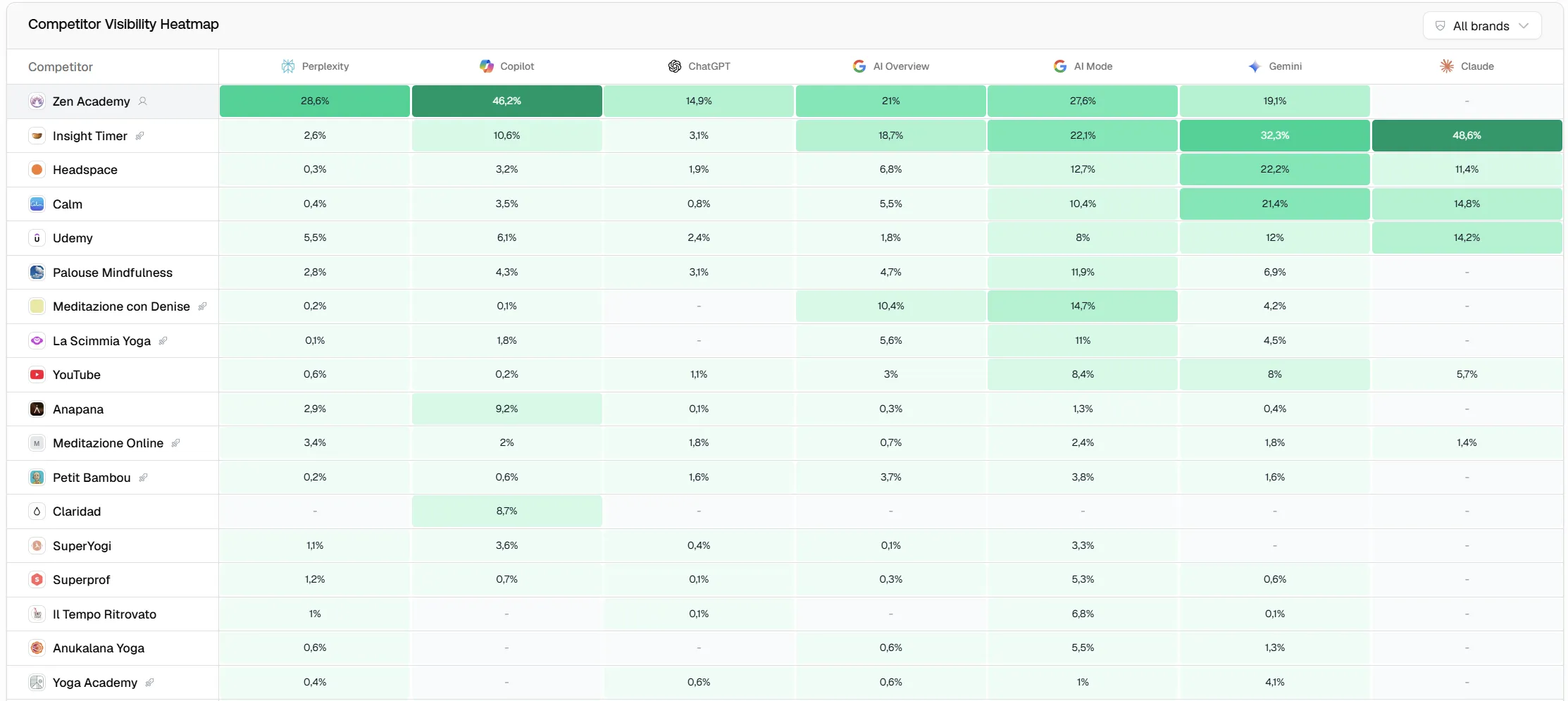
Competitors show the same split. On Perplexity and Copilot, Zen Academy (local brand) holds more visibility than Insight Timer. On Gemini, the order flips: Insight Timer 32.3%, Headspace 22.2%, Calm 21.4%, Zen Academy 19.1%.
Gemini is the only platform with live web search where the global English-language apps beat the local specialist. (Claude appears in the heatmap, but without web search it has nothing to say about a small Italian brand.)
Tactics I would keep, and why
AI summary block. Three bullets with the key points, at the top of the article. My hypothesis is that it hands the platform a self-contained answer it can lift without reading the whole page. It is cheap to add and easy to remove, which makes it the tactic I would test first on another site. It is also quite user friendly (let’s be honest, who has time to read an article like this one?).
FAQ block. Question headings followed by short, direct answers. Both FAQ blocks also carried FAQPage structured data, which I am not evaluating in this article, so any effect belongs to the two together.
A named person with a face. One sentence naming Zen Academy’s founder, plus her own experience of learning to meditate, establishes that a real person with real expertise stands behind the content. As more and more of the web becomes derivative or AI-written, first-hand experience is the one thing a model cannot assemble from other sources.
Google has been pushing the same principle for years: show who created the content and why they are qualified to. AI platforms raise the stakes, because a model building a recommendation has to decide whose claim to repeat.
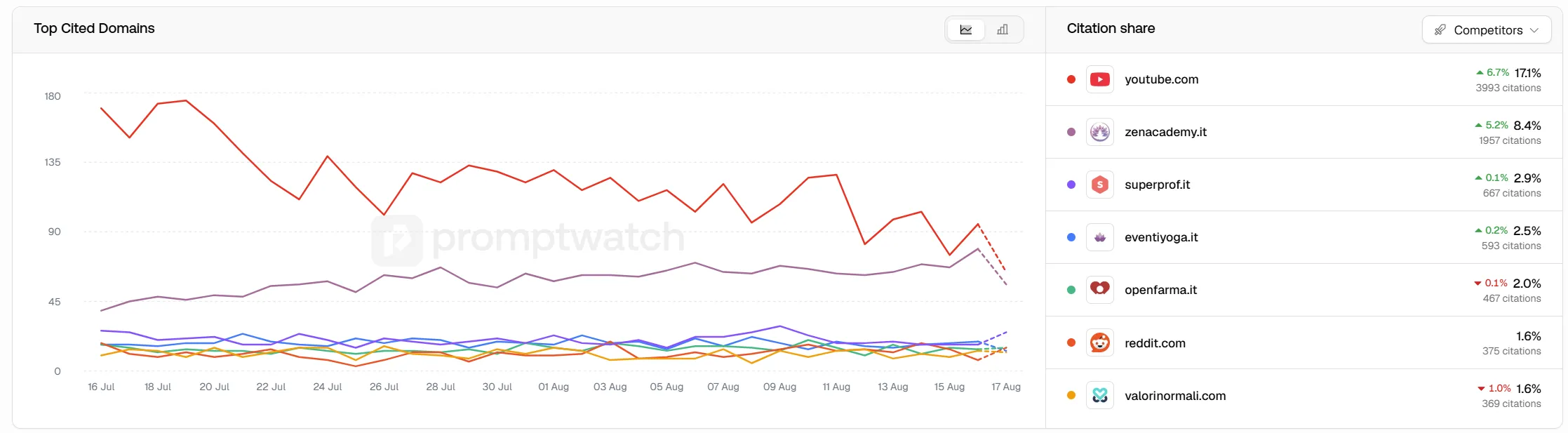
YouTube videos. YouTube is the single most-cited domain in my dataset on three separate tools: 2,686 citations on Perplexity, 640 on AI Mode, and 629 on AI Overviews. On Perplexity, that is about a third of every citation it produced across seventeen prompts. Publishing on YouTube puts your content into a source these tools already read constantly, whether or not anyone judges the person on camera. Still, what I tested was embedding the video in one article, and I cannot separate its effect from the other changes to that page. The case for it rests on where the video lives.
The site-wide changes (llms.txt, the Reddit mention, the unlinked database mention, the Trustpilot profile) went live between July 31 and August 3 and affect every page at once, so this data has no way to separate their effect from everything else. The only hint is timing: Perplexity’s climb overlaps with them. I also noticed that Trustpilot was pulled as a source more often in commercial prompts. But that is about it.
The listicle problem
On July 21, I published a comparison listicle on my own site (Best online meditation courses in Italy), recommending my own courses among others. Just out of curiosity. Within weeks it became one of the most-cited URLs in the dataset. This works, and it should not.
I wrote it for the AI platforms and for nothing else.
By mid-August it ranked among the top-cited URLs for the whole project, with 268 citations and an average position of 3.4. It is also the cleanest evidence in this article: the page did not exist before July 21, so every citation it received came from the change itself.
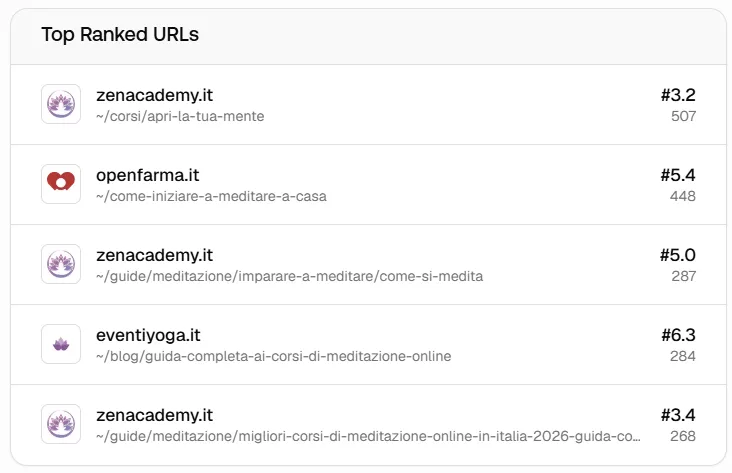
Honestly, this tactic makes me uncomfortable. A tool assembling an answer to “which online meditation course should I buy” retrieved a comparison written by one of the parties being compared, used it, and named the brand that owns the page. No neutrality check happened anywhere in that chain. The tool asked nothing, and there was nowhere for me to disclose anything.
This is not a Zen Academy quirk. I have watched the same tactic work across unrelated sectors on client projects, which is exactly why I was comfortable trying it where I could publish the results.
A course roundup on corsidia.com collected 138 citations on Perplexity alone during the experiment. AI platforms want a page that has already done the comparing, and whoever supplies that page supplies the answer.
This is the keyword stuffing of our era. A mechanical, obviously gameable signal that works because the system has not yet learned to discount it. I expect the platforms to start classifying comparison sources by independence, weighting third-party and editorially neutral listicles above self-published ones, and treating a company that ranks itself against its competitors with the skepticism it deserves.
Until then, it works. I am reporting it because it is true, and flagging it because a strategy built on it is built on a signal with a visible expiry date.
What prompt trackers do not tell you
A prompt tracker reports numbers with two decimals. Before trusting them, check what they actually measure.
I found three gaps in mine, and I doubt they are unique to it. There is also one partial fix.
It could not run Claude the way people use it
I already mentioned in the Methodology section that the only Claude configuration Promptwatch offered as of July 2026 ran without web search, so it answered from training data alone. Across 95 responses collected between July 12 and 18, 2026 (the monitor ran for a few days before the experiment window opened on July 16), it produced zero citations.
It also named no Italian brand at all. It recommended Insight Timer in 41% of answers, then Headspace, Calm, Udemy, Waking Up, and Meditopia: global, English-language brands with a decade of web presence, the kind that survives compression into model weights. The entire Italian market disappeared.
That is an interesting finding about models without retrieval. A model that never reads websites cannot reward changes to a website. I watched that number for a week before I noticed.
Most trackers do not let you choose the model or its configuration. You get a slot labeled with a platform name, and behind it sits whichever endpoint was cheapest and most stable to connect.
Giorgio Taverniti (in Italian) says he has developed an allergy to prompt trackers that never track what a person actually uses. What I want is a tracker that simulates the default experience: default model, default settings, web search on wherever the product ships with it on.
The main visibility metric only accounts for mentions
As the KPI section showed, Gemini names brands often and links to almost nothing. A mention builds awareness; a citation can send a visit.
A single visibility score based on mentions does not tell the whole story.
It split my brand into several brands
Inside Promptwatch, Zen Academy exists as several separate entities. “Zen Academy” is the one marked as mine. Alongside it sit “Zen Academy Italia” and “Zen-Academy,” both attached to the same domain, plus entries named after Zen Academy’s own courses. None of them count toward my visibility score.
So my real visibility is probably higher than the numbers in this article, by an amount I cannot measure: some of those mentions will have appeared in answers that also named “Zen Academy,” and some will not. Entity resolution is hard, and every tracker does it with imperfect signals.
Open the brand list before you open the dashboard, and reconcile it before you report anything to a client.
The partial fix: numbers from the platforms themselves
Two platforms now report AI visibility directly.
Bing Webmaster Tools added an AI Performance report in February 2026. It counts how often your pages are cited in Copilot and Bing’s AI answers, page by page, and shows a sample of the grounding queries the AI used to retrieve them. It mixes Copilot with Bing’s AI summaries and partner integrations, with no way to separate them.
Google followed on June 3, 2026, with a generative AI performance report in Search Console covering AI Overviews and AI Mode. It shows impressions by page, country, device, and date, with no clicks and no queries. After a staged rollout, it reached every website on August 31.
Neither covers ChatGPT, Perplexity, or Gemini, and neither tells you what a person actually typed.
Taverniti’s position is that the only responsible way to work right now is evidence-based, starting from Search Console, which is why his team built its agent tooling on AI Overviews. He is also openly unimpressed with how late and how thin that data is. I agree on both counts: impressions without queries tell you that something happened and leave out what triggered it.
So weigh my claims accordingly. What I report about Copilot and Google’s surfaces can be checked, at least in part, against the platforms’ own data. What I report about ChatGPT, Perplexity, and Gemini rests entirely on third-party sampling.
Start with a brand profile
The most useful output of a month of experiments was a change in where I think this work starts.
I set out to find which GEO tactics work. I came away with a partial answer to that, and a much clearer answer to two questions I had not asked.
The AI platforms differ from each other more than they resemble each other. And the trackers built to measure them are further behind than their dashboards suggest.
Prompts are downstream of something most brands have never written down. Before you can ask what people are asking, you need a complete profile of what you are: what you actually offer, what you want to be known for, what your site communicates whether you intended it or not, and what the open web says about you when someone looks you up.
Build that profile properly and most of the prompts write themselves, because the gaps become visible:
- What you offer that nobody else does tells you where you should be winning.
- What competitors are credited with that you are not tells you what to fix.
- Where your site’s version of you diverges from the web’s version of you is usually the most expensive problem, and the least noticed.
I am building a tool to produce that profile, just for fun. It is not finished, and I am still testing what belongs in it.
What is next
Part 3 will go deeper into the differences between the AI platforms themselves. It is the thread I keep pulling, and it keeps unraveling further.
I will also report on the brand profile tool, assuming it survives contact with a second project.
